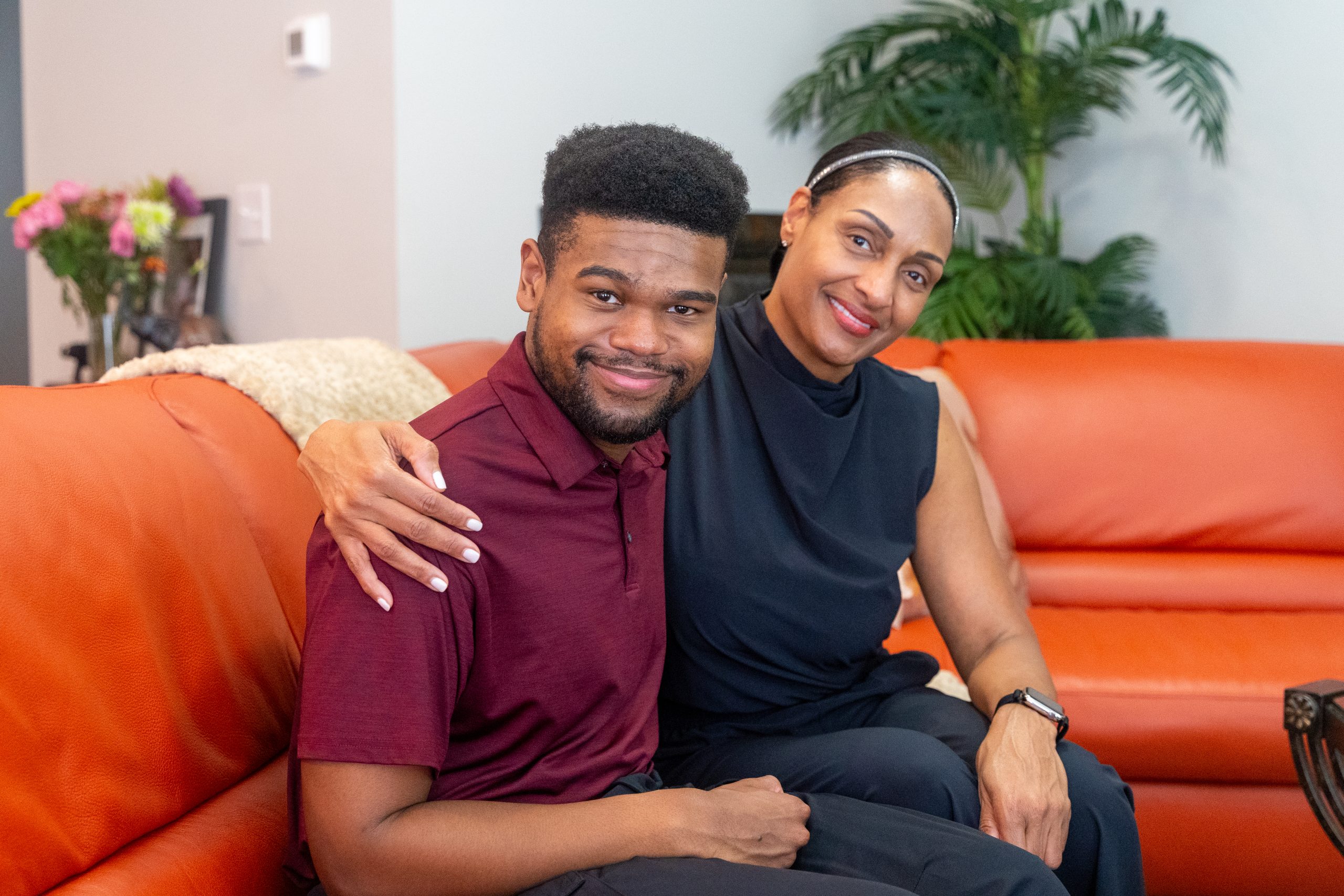
She calls him her “miracle baby.” When he came into this world 28 years ago, Treveous did not cry and did not breathe. After a long and difficult delivery, his mom, Kristine, was watching the doctors resuscitating her newborn baby. Right there, they told her he wouldn’t live past two. When she heard the prognosis, she refused to accept it. Kristine remembers being in the hospital room and holding her newborn’s foot. “I told the doctor that I am looking for an expiration date,” she smiles today when she recalls that moment.
Her faith kept her going.
The path was hard. The first six months of his life he spent at the NICU. He is quadriplegic, has cerebral palsy, and multiple accompanying conditions. He can’t feed himself independently. He went through multiple surgeries combined with a lot of illnesses.
Now, Treveous is a grown man and can do a lot of the things the doctors told his mom he wouldn’t be able to do. “I was adamant about not letting him just be in a persistent vegetative state and let me teach him as much as I could. He knows how to put on his shirt, he knows how to put his arms through the sleeves. He knows how to brush his teeth. He helps me, even when I’m changing his diaper, he knows how to pull his pants. He’s a very smart kid,” Kristine says.
Kristine opened a Special Needs Trust for her son to help her cover the expenses that come with his disability, and she became his co-trustee. Two years ago, her trust was transferred to Georgia Community Trust (GCT) of BDI (Bobby Dodd Institute) without any warning or formal communication.
But today, she’s glad that this happened. “From that point forward, my experience has been very, very good. I’ve not had any issues in reference to getting any of the funds I needed.” Even the day-to-day processes, like reimbursements, are not an obstacle now.
As the relationship with GCT developed, the practical support became smoother too. When ordering supplies for her son, the process became almost routine.
In fact, access to funds and approvals became something she no longer had to worry about. “I’ve not had an issue really at all with getting any assistance with funds. Sometimes it’s been short notice, but it’s been handled very quickly when I needed it to be,” Kristine says.
She describes the shift as deeply personal. “It’s comforting to have somebody you can trust in handling his funds, because we’ve had so many people prior to BDI that have lined their own pockets. And that’s the difficult part because I’ve had to take people to court to get his funds,” Kristine shared with great relief.
For her, stability meant a system she no longer has to question every step of the way, and one that finally allows her to focus back on her son and her family. And for the first time in four years, she and her husband were able to go on a vacation together, knowing that Treveous’s future is protected.