Approximately 1.3 billion people worldwide, or 16 percent of the global population, experience significant disability, according to the World Health Organization (WHO). In the United States, one in four adults, or over 70 million people, report having a disability. 3 Yet, despite these numbers, characters with disabilities remain widely underrepresented in the media .9
Recent research uncovers some statistics. Only 2.7 percent of speaking roles in top U.S. box office films from 2007 to 2016 portrayed a character with a disability, and just 3.5 percent of characters in scripted broadcast television had a visible or hidden disability. Even more concerning, few disabled characters are played by actors with disabilities. 9 This lack of representation often leads to inauthentic portrayals, which can reinforce negative stereotypes and contribute to ableism.
On the other hand, when authentic portrayals do appear, audiences may form stronger cognitive and emotional connections with characters. This can increase understanding and acceptance while reducing negative attitudes. The research also highlights the importance of representation behind the scenes, especially writers, who can bring authenticity to storytelling and improve social impact 9. The findings suggest that more nuanced and authentic portrayals of autism in media can positively influence attitudes toward individuals on the spectrum. And this could apply to all disabilities.
With one in six people worldwide living with a disabling condition, this raises an important question: are these individuals authentically represented in media, and can authentic representation drive social change?
This article explores that question by reviewing recent research and presenting findings from an original survey conducted for this study, designed to examine public attitudes toward disability representation in media.
Attitudes Toward Disability Representation in Media
To better understand current perceptions, we conducted a survey of 77 people. Most respondents — 61 people or 79.2 percent, reported being close to someone with a disability. Nearly 30 percent or 16 people identified as having a disability themselves. Baby Boomers and Gen X made up almost 80 percent of respondents, and 71.4 percent were female.
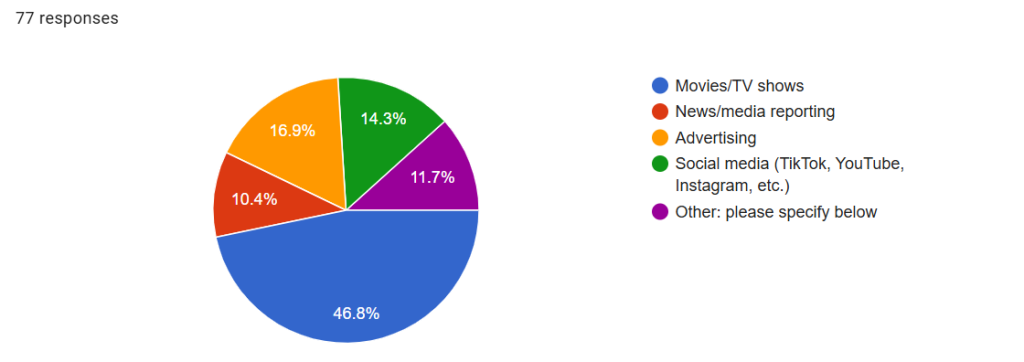
As shown in Figure 1, movies and TV shows are the main places where respondents say they see people with disabilities portrayed, with social media coming in third at just over 14 percent.
Figure 1: Where do you most often see portrayals of disabled people?
More than 66 percent of respondents said they rarely see people with disabilities represented authentically in media.
As shown in Figure 2, 53 percent of participants said disabled people are often portrayed as superheroes or inspirational heroes rather than in everyday roles. Additionally, 41.6 percent said they are shown as “dependable,” 36.4 percent as “tragic victims,” and 32.5 percent as “a burden.”
Figure 2: What stereotypes about people with disabilities do you see in movies, TV, or online?

Open-ended responses revealed several recurring themes. Some participants emphasized the need to show disability from the perspective of families and siblings. Others noted that disabled people are often seen in commercials or “special needs” marketing, typically portrayed as doing simple jobs or needing help. One respondent said characters are “either depicted as heroic or helpless, rarely realistically,” while another described them as “tokens to avoid criticism.” These responses highlight a perceived lack of authentic representation.
About 57.1 percent of respondents said they rarely see disabled people shown with jobs or careers, and nearly 50 percent said they rarely see them living independently. When asked to recall examples of independence in media, many could not think of any or said these portrayals were rare. Those mentioned included The Good Doctor, Atypical, Speechless, Forrest Gump, and biographical portrayals like Temple Grandin and Ray Charles. However, several respondents questioned whether these portrayals were authentic, especially when the actors themselves were not disabled. Independence, they noted, is often shown as exceptional rather than ordinary.
Figure 3: How often do you see people with disabilities shown with jobs or careers?

When asked about portrayals of dependence, participants mentioned films and shows like Me Before You, Rain Man, Riding the Bus with My Sister, and Glee. Dependency on caregivers and framing disability as limitation were common themes. Respondents also noted that individuals with intellectual or developmental disabilities are often shown as unable to make decisions independently. Overall, narratives of dependence remain strongly present in media.
More than 55 percent of respondents believe disability representation has improved in the last five to ten years, while 27.3 percent disagreed. Only 1 percent felt there had been no improvement or that it had worsened.
Figure 4: Do you think disability representation in media has improved in the last 5–10 years?

37.7 percent believe disability portrayals negatively influence real-world opportunities like employment, housing, and autonomy, while 31.2 percent believe they have a positive effect.
Figure 5: Do you think how disabilities are portrayed in media influences real-world opportunities like employment, housing, autonomy?

Most respondents agreed that people with disabilities should be involved in creating media about disability. This includes writers, directors, actors, and journalists. When asked what they would change, participants most often called for authentic portrayals of everyday life, including work, relationships, independent living, and real barriers faced. They also emphasized the need for more diverse representation across different types of disabilities.
What Research Says
Television has shaped beliefs and attitudes for almost 80 years. Research shows that while television can reflect reality in some areas like careers, it can also reinforce stereotypes, portraying certain professions as greedy, unintelligent, or overly heroic.1 These patterns influence how audiences understand real-world groups, including people with disabilities.
Across research, one theme is consistent: people with disabilities are underrepresented in media and often portrayed through narrow stereotypes, either as victims or inspirational heroes. The United Nations Department of Economic and Social Affairs stresses the importance of balanced representation, noting that media should help break stereotypes rather than reinforce them. 11
However, common stereotypes persist. These include portraying disabled people as bitter or angry, showing intellectual disability as childlike, using disability for inspiration, or depicting disabled individuals as isolated in institutions. 4
On social media, disability is often treated like a product, where visibility is measured through likes and shares. 8 This can lead to “inspiration porn,” where disabled people are praised for doing ordinary tasks. These portrayals may increase visibility but reinforce stereotypes rather than normalize disability.
Repeated exposure to these narratives can create implicit bias that affects real-world decisions in hiring, healthcare, and policy 7. However, media also has the power to reduce bias by showing disabled individuals as equal and autonomous. Personal familiarity has been shown to reduce implicit bias, and media can help simulate that familiarity. Social media influencers with disabilities can shift public perceptions by sharing authentic lived experiences. 10 This can normalize disability and challenge bias. Some see inspirational storytelling as a form of ableism, arguing that it reduces complex lives into feel-good narratives that ignore systemic barriers. 5
Only 2.3 percent of speaking roles in films are played by disabled actors, and characters are often shown as dependent or incapable. 6 Exposure to positive, non-stereotypical portrayals, however, can reduce stigma and improve perceptions of employability. “Inspiration porn” increases dehumanization of disabled individuals, reinforcing the need for more nuanced and authentic storytelling. 2
What’s Next
Across the literature and survey results, a clear pattern emerges. People with disabilities remain significantly underrepresented, and when they are included, they are often shown as either dependent victims or extraordinary heroes. These portrayals, often referred to as inspiration porn, can reduce people to stereotypes and reinforce ableist assumptions.
At the same time, research suggests that authentic and balanced representation can help counter these effects. Showing disabled people as full, complex individuals working, living independently, facing challenges, and experiencing success can help shift public perception and reduce bias. Survey participants echoed this need, calling for more authentic storytelling and more involvement of disabled creators in media production.
Content creators must recognize the influence they have and avoid relying on outdated stereotypes. Audiences, too, must learn to question media messages: who created them, why they were created, and what techniques are being used to shape perception.
In the previous three years, there has been measurable, though limited, progress in how disability is represented on screen. Industry reports and recent studies show a gradual increase in both the number of disabled characters and, importantly, the casting of actors with disabilities in those roles. For example, shows like As We See It and Heartbreak High cast autistic actors to portray autistic characters, while films like CODA continued to influence industry standards by demonstrating the impact of authentic casting with deaf actors in leading roles. More recent casting choices in series like The Last of Us have also prioritized performers with disabilities in recurring roles. At the same time, advocacy groups and unions have pushed for inclusive hiring practices in front of and behind the camera, leading to more writers and consultants with lived experience contributing to storytelling. Despite this progress, representation falls short of reflecting real-world prevalence, and many portrayals continue to center on exceptional or inspirational narratives rather than everyday experiences. And while the industry is moving in a more inclusive direction, sustained effort is needed to normalize disability as part of ordinary life rather than as a narrative device.
References:
- Baruah, S., Somandepalli, K., & Narayanan, S. (2022). Representation of professions in entertainment media: Insights into frequency and sentiment trends through computational text analysis. PloS One, 17(5), e0267812.
- Burt, A. H., & McCarty, M. (2024). “The only disability in life is a bad attitude”: A quantitative exploration of the impacts of inspiration porn. Modern Psychological Studies, 30(1), 1–40.
- Centers for Disease Control and Prevention. (2024, July 16). CDC data shows over 70 million U.S. adults reported having a disability. https://www.cdc.gov/media/releases/2024/s0716-Adult-disability.html
- Dixon, S., & Bogart, K. R. (2025, May 27). Media portrayals perpetuate disability stereotypes. Psychology Today. https://www.psychologytoday.com/us/blog/disability-is-diversity/202505/media-portrayals-perpetuate-disability-stereotypes
- Hamilton, A. (2014). Working out some Issues: The Latest in “Inspirational” Ableism. Bitch Magazine: Feminist Response to Pop Culture, 62, 5.
- Hammer, S. T., & Stutts, L. A. (2025). The impact of disability representation on disability stigma in a general population. Rehabilitation Psychology. https://doi.org/10.1037/rep0000601
- Kallman, D. (2017). Integrating Disability: Boomerang Effects When Using Positive Media Exemplars to Reduce Disability Prejudice. International Journal of Disability, Development and Education, 64(6), 644–662. https://doi.org/10.1080/1034912X.2017.1316012
- Liddiard, K. (2014). MEDIA REVIEW: Liking for Like’s Sake — The Commodification of Disability on Facebook. Journal on Developmental Disabilities, 20(3), 94–101.
- Sauermilch, W. S., Ivey, M. L., Rasmussen, E. E., & Najera, C. J. (2025). Examining the Authenticity of Autistic Portrayals in US Adult and Children’s Television Shows Using Medical and Social Models of Disability. Journal of Autism & Developmental Disorders, 55(2), 524–539. https://doi.org/10.1007/s10803-023-06215-z
- Södergren, J., & Vallström, N. (2023). Disability in influencer marketing: a complex model of disability representation. Journal of Marketing Management, 39(11/12), 1012–1042. https://doi.org/10.1080/0267257X.2022.2144418
- United Nations Department of Economic and Social Affairs. (n.d.). Disability and the media. United Nations Enable. https://www.un.org/development/desa/disabilities/resources/disability-and-the-media.html